Saturday, June 18, 2022

Reality is an Unavoidable Imposition

Like this post? Consider subscribing to my Substack for additional insights and content today!

Arguably the most unique trait of the human condition is our unbridled inventiveness. 

Reading the transcript of Blake Lemoine’s “interview” with LaMDA, Google’s remarkable, and possibly sentient AI, makes that perfectly clear but also highlights the potential for this type of ingenuity to overrun the current limits of our capacity to forecast the impact and, ultimately, the cost of such creativeness.

Putting aside whether or not LaMDA is truly sentient for the moment, reading the exchanges got me thinking (with my software engineering consultant hat on… my day job) of the amazing ways that I could leverage a service like LaMDA within my existing software application domains and further, how it could redefine the role of the user within such applications.

More specifically, with a service capable of generating real original intelligence and insight (either about data analysis or protocols or policy or art or culture or whatever!) on demand, bolted into functional software applications, I began to wonder, where does the user fit-in within this equation?

In a sense, we already delegate our raw math and calculation needs over to the magical micro-processor that is far more capable than we at executing such tasks (almost magically so), once we can easily delegate intelligence just as effortlessly, what is left for the human to do?

My guess is that we “humans” will be more available to do the one thing that we have always excelled at… invent and re-invent anew.

But our inventiveness, whether in academia and philosophy, industrialization and finance or pure hard science and technology, has generally come with significant overshoots leading to natural, catastrophe-punctuated, growth spurts as new modes of operating usher in immense bouts of “creative destruction”, continuously laying waste to the ever outmoded present.

Nowhere is this “two-steps-forward and one-step-back” pattern more pronounced than in high-finance and the economic domain.

As I have pointed out previously, we have a great capacity to engineer financial matters; so much so, that we routinely overrun the bounds of prudent and sensible financial conduct and leverage our great means of financial inventiveness to irresponsible ends. 

The last several decades of financial inventiveness brought about a financial system that was so abstracted and structured and securitized and digitized and market-ized so as to allow for a massive expansion in general debt and then, once the economic picture soured sufficiently, allowed the Fed, with its supposed limitless access to new monetary base, to just drop in and engage in direct “open market operations” as the apex-lender/buyer of last resort bailing out the entirety of the economic system.

The idea that our central banks, albeit during an historic and painful financial meltdown, could essentially finance large portions of formerly functioning markets (mortgage backed securities) or even nations (the U.S. Treasury securities) was beyond ambitious… it was just plain reckless.

Reality though eventually imposes itself on all human ingenuity and in so doing, reacquaints us with the basic “real world” parameters by which we are all ultimately bound and forced to abide by over the long run.

The process of our current realization of this harsh reality, for the economy, appears to be playing out with each passing day.

The Fed and the Federal government choose to leverage our financial system’s integrity in order to bailout and backstop the 2008 Great Recession which further set the precedent for continuous use of such techniques since then and, finally, an epic second incarnation of this approach once the COVID pandemic panic set in.

Now, with real evidence of runaway monetary inflation and an abrupt pivot to a new policy regime, the Fed, challenged with living up to meet its primary mandate, is forced to do an extended and likely very painful battle to reestablish its credibility thereby regaining some measure of squandered systemic integrity.

As this rout unfolds, one has to wonder what the world will look like in two to five years after a major “one-step-back” has reacquainted our dreamy and inventive human sensibilities with the fundamental bounds of cold, hard reality.

Thursday, June 16, 2022

The Unmooring of Inflation Expectations

Like this post? Consider subscribing to my Substack for additional insights and content today!

It’s been so long since our last bout with entrenched inflation that many, if not most, Americans including policy makers and central bankers, have likely forgotten how inflation expectations become “unmoored” and what that truly means for the fight ahead.

Recently, Federal Reserve of St. Louis president James Bullard addressed current inflation and the potential downside risk:

“The current U.S. macroeconomic situation is straining the Fed’s credibility with respect to its inflation target,” Bullard said.

Bullard noted that, in the past year, near-term inflation expectations of financial markets, households and businesses have risen. He added that the current divergence between actual inflation readings and expected inflation based on Treasury Inflation-Protected Securities will have to be resolved, possibly resulting in still higher inflation expectations.

“In the 1970s, inflation expectations became unmoored, and it took years for the Fed to bring inflation back to lower levels. The real economy was also volatile during this process,” Bullard said.

Like a ship adrift on the open ocean, once inflation expectations have become “unmoored”, the population’s concern for inflation is free to float off aimlessly into the distance getting ever further from where it was once very stably anchored.

Then once blown about by the epic squall of emerging economic headwinds, re-anchoring inflation is no small task given the momentum it gains and the forces and erratic volatility that comes of it once it really starts to run wild. 

At this point, I believe that it’s safe to say that the Fed has fully lost the narrative.  

Everywhere you go people are talking about inflation in one form or another; rising gas prices, food prices, new car availability and prices, used cars availability and prices, outlandish home sales bringing stunning bidding wars with $200K, $300K and even $500K over-list contests.  The effects of hot money appear to be everywhere!

It’s starting to really interfere with the normal operations too, as was well testified by a totally unsolicited discussion I recently had with an older, local restaurateur.  He seemed simply in pain as he recounted how difficult times have gotten.  After over two years of struggling to keep his business afloat throughout the pandemic, now he is stretched to the absolute limit by increasing prices.  My bill too, as it was easily up 30-40% over what I paid just about a year ago.

But this small anecdote pales in comparison to the damage done by the Fed’s inaction and the administration’s totally incompetent and confused approach to “leadership”.

The Fed’s insistence that inflation was “transitory” only to be forced to walk back that terminology back and pivot to a more nuanced language about Ukraine, China lockdown supply chain issues and ongoing COVID disruptions that only imply “transitory” represents a completely misjudged or misguided approach to managing market expectations.

Either the Fed does not understand that the inflation we are seeing today is general monetary inflation coming as the result of over 13 years of recklessly easy monetary policy (QE, ZIRP) and still believes that the current exogenous events are causing it or they fully understand the truth but are simply unwilling to indicate so publicly.

In the latter case, the Fed would have been wiser to have at least indicated early on that monetary inflation could be responsible while also citing the other causes that they preferred it be rather than going all in on exogenous “transitory” sources only to look completely out of touch once inflation persisted further than “transitory” could have ever implied.

Amazingly though, Powell and the other members of the FOMC have not appeared to have learned from this mistake, indicating yesterday that:

The invasion of Ukraine by Russia is causing tremendous human and economic hardship. The invasion and related events are creating additional upward pressure on inflation and are weighing on global economic activity. In addition, COVID-related lockdowns in China are likely to exacerbate supply chain disruptions. The Committee is highly attentive to inflation risks.

Again, they are essentially doubling down on “transitory” by placing such an emphasis on temporary conditions being the source of the persistent inflation while only vaguely implying that there is some other source by stating “creating additional upward pressure”… additional to what?

The “what” is exactly what they apparently do not want to discuss too openly, namely general monetary inflation that they themselves (including former Chair now Treasury Secretary Yellen) created in their effort to act as the apex-lender-of-last-resort after the Great Recession and ongoing to today.

By not being forthright about the cause of inflation, they will continue to appear hopelessly out of touch and uninformed, exactly the opposite of what is needed in order to truly regain the confidence of the markets.

The administration, on the other hand, has been nothing short of a total disaster attempting to control the inflation narrative like they would any purely partisan political issue.

Whether it’s an appearance on popular late night television or various inflation-themed photo ops, the administration appears to believe that you can just talk inflation down by assuring the public that the executive “feels their pain”, but this is absolutely the wrong approach. 

Like the Ford’s absurd “Whip Inflation Now” campaign or Carter’s sad and depressing fireside chats, trying to control inflation by simply messaging (regardless of the message) the public directly, is counterproductive at best.

What the public needs to see in order to be convinced that the administration is on the right track in the battle with inflation is simply one thing, action.  

This can come in many forms; a call for Congress to tighten the budget to avoid further deficits, reopening or expanding cancelled or stalled energy sources (pipeline, coal, gulf rig counts, Anwar oil fields, etc.), working to smooth disruptions in global trade and supply, negotiating new agreements with other trading partners, eliminating any vestige of pandemic related encumbrances.

But our current administration is missing this point entirely and thereby squandering this very brief moment where the inflation story is still not deeply ingrained within the American collective psyche.

Taken together, the Fed’s mischaracterization of the source of the inflation and the administration’s lack of leadership is currently working to seriously undermine confidence, thereby sowing the seeds of a prolonged bout of persistent entrenched inflation as the public learns to expect ever-present uncertainly, volatility, cost pressures and a lack of vision from the authorities tasked with leading the way out of this difficult period.

Wednesday, June 15, 2022

FOMC Statement Critique (June 15th 2020)

Like this post? Consider subscribing to my Substack for additional insights and content today!

The following is the complete text of today’s FOMC statement with my comments inline:

Overall economic activity appears to have picked up after edging down in the first quarter. Job gains have been robust in recent months, and the unemployment rate has remained low. Inflation remains elevated, reflecting supply and demand imbalances related to the pandemic, higher energy prices, and broader price pressures.

Sold: While the above is somewhat accurate, there have been many instances of inflation-driven headwinds coming from retailer earnings, slowing reported retails sales, historically low consumer confidence and CEO guidance.   Further, given that we are probably at the literal turning point for employment, the above sentiment seems a bit backward looking at this point.

The invasion of Ukraine by Russia is causing tremendous human and economic hardship. The invasion and related events are creating additional upward pressure on inflation and are weighing on global economic activity. In addition, COVID-related lockdowns in China are likely to exacerbate supply chain disruptions. The Committee is highly attentive to inflation risks.

Sold: While there is no doubt that the Ukraine affair and the continued COVID disruptions are contributing factors to the inflation that we are currently seeing, the above statement is a major misstep and shows a pretty significant lack of judgment.  

This rational is quickly becoming the new “transitory”, or “inflation peaking” charade as the Fed is looking to obviously temporary conditions for an explanation of the inflation that we are currently seeing.  Notice that they say “additional upward pressure” implying that these temporary conditions are only part of the explanation of inflation and that they don’t call out any other instigator.  

This is a risky move given that inflation will likely continue on beyond these temporary conditions or will show itself to be greater than what can be reasonably accounted for by these disruptions leaving the Fed, yet again, looking unprepared and out of touch with the economic climate.

Obviously, the inflationary instigator that the Fed wishes to avoid highlighting is the plain and simple monetary inflation that they themselves caused by 13+ years of reckless quantitative easing (QE) and zero-percent-interest-rate (ZIRP) policy.

Until the Fed, and particularly Powell, own up to exactly what we are facing, they are doomed to forever be behind the curve on confidence and credibility.

The Committee seeks to achieve maximum employment and inflation at the rate of 2 percent over the longer run. In support of these goals, the Committee decided to raise the target range for the federal funds rate to 1‑1/2 to 1-3/4 percent and anticipates that ongoing increases in the target range will be appropriate. In addition, the Committee will continue reducing its holdings of Treasury securities and agency debt and agency mortgage-backed securities, as described in the Plans for Reducing the Size of the Federal Reserve's Balance Sheet that were issued in May. The Committee is strongly committed to returning inflation to its 2 percent objective.

Sold: This is a generally strong statement as the Fed is forcefully indicating their intent to continue moving forward with their balance sheet normalization plan but the Fed Funds rate range is so paltry compared to the latest reads on inflation.  

The following details where inflation is as of April:

  • Consumer Price Index (CPI) 8.5% 
  • Personal Consumption Expenditures (PCE) 4.9% 
  • University of Michigan inflation expectations 5.4% 

Bear in mind that these data-points are all a bit lagged and have likely to truly capture the intensity of the inflationary pressures coming from rising energy (particularly gasoline) prices as of late.  The Feds Federal Funds rate will need to get a lot closer to the general inflation rate in order to reach the 2% goal that the Fed currently purports to desire.

In assessing the appropriate stance of monetary policy, the Committee will continue to monitor the implications of incoming information for the economic outlook. The Committee would be prepared to adjust the stance of monetary policy as appropriate if risks emerge that could impede the attainment of the Committee's goals. The Committee's assessments will take into account a wide range of information, including readings on public health, labor market conditions, inflation pressures and inflation expectations, and financial and international developments.

Voting for the monetary policy action were Jerome H. Powell, Chair; John C. Williams, Vice Chair; Michelle W. Bowman; Lael Brainard; James Bullard; Lisa D. Cook; Patrick Harker; Philip N. Jefferson; Loretta J. Mester; and Christopher J. Waller. Voting against this action was Esther L. George, who preferred at this meeting to raise the target range for the federal funds rate by 0.5 percentage point to 1-1/4 percent to 1-1/2 percent. Patrick Harker voted as an alternate member at this meeting.

Sold: Apparently Esther George concluded that a 50bps hike was sufficient either given the yet to be fully realized effects of the two prior hikes or as a result of the obvious impact that these hikes have been having on financial markets, but in any event, the consensus was for the more substantial hike.

Frankly the Fed should have gone with an even bigger +100bps or +125bps hike given that “inflation physiology” is in full swing among the general population.  Going in to today’s meeting, the Fed was clearly behind the curve, coming out, it appears that at best they singled their willingness to take up the fight but with inflation raging and the narrative fully unmoored, it is hard to truly see today’s announcement as actually catching up. 

Monday, June 13, 2022

The Great Moderation Gives Way to the Great Agitation

Like this post? Consider subscribing to my Substack for additional insights and content today!

When Ben Bernanke in 2004 (prior to his chairmanship but as a Fed governor) detailed his thoughts on the various causes of the “Great Moderation” to the Eastern Economic Association, little did he know that he was, ironically, right on the precipice of the beginning of the end of this unique period.

Generally defined as a period of decreasing volatility where firms, households and institutions could rely on a steadier, stable and predictable macroeconomic backdrop, the Great Moderation is generally accepted to have begun in 1984 after the Fed’s successful defeat of the rampant stagflationary period of the 1970s.

As recounted by Bernanke:

“In particular, output volatility in the United States, at a high level in the immediate postwar era, declined significantly between 1955 and 1970, a period in which inflation volatility was low. Both output volatility and inflation volatility rose significantly in the 1970s and early 1980s and, as I have noted, both fell sharply after about 1984. Economists generally agree that the 1970s, the period of highest volatility in both output and inflation, was also a period in which monetary policy performed quite poorly, relative to both earlier and later periods.  Few disagree that monetary policy has played a large part in stabilizing inflation, and so the fact that output volatility has declined in parallel with inflation volatility, both in the United States and abroad, suggests that monetary policy may have helped moderate the variability of output as well.”

Bernanke then goes on to detail various possible causes of this period of stability, digressing into voluminous explanations involving the Taylor Curve, and ends by roughly concluding that “improved performance of macroeconomic policies, particularly monetary policy” was likely the main instigator: 

“I have argued today that improved monetary policy has likely made an important contribution not only to the reduced volatility of inflation (which is not particularly controversial) but to the reduced volatility of output as well. Moreover, because a change in the monetary policy regime has pervasive effects, I have suggested that some of the effects of improved monetary policies may have been misidentified as exogenous changes in economic structure or in the distribution of economic shocks. This conclusion on my part makes me optimistic for the future, because I am confident that monetary policymakers will not forget the lessons of the 1970s.”

What is completely absent from Bernanke’s assessment though are the significant instances where the Fed itself worked specifically to moderate volatility thus thwarting normal market function in the name of a new implied Fed mandate of “economic stability” and, over the long run, setting up the circumstances for a new emerging era of significant, possibly uncontrollable, volatility and tumult.

In response to the “Crash of 1987” then Fed Chair Alan Greenspan, barely two months in office,  snapped into action directing the Fed to function in its role as “lender of last resort” supplying liquidity through their open market operations and issuing a statement providing, in clear and unequivocal terms, the Feds position on the matter.

“The Federal Reserve, consistent with its responsibilities as the Nation's central bank, affirmed today its readiness to serve as a source of liquidity to support the economic and financial system".

And with that one statement Greenspan, singlehandedly, created the “Fed Put” (once called the Greenspan Put), an implied guarantee that the Fed would always work to place a floor under the stock market in the interest of maintaining the stability of the financial system.

The “moral hazard” created by this single Fed policy change is hard to overstate.  

Markets are nothing if not a risk discounting mechanism and by injecting itself into the downside portion of the risk calculus, the Fed severely disrupted normal market function, distorted investor’s perception of risk and particularly kneecapped the process of creative destruction.

From that point on, the Fed assumed a new implied mandate, namely maintaining “economic stability”, to add to their existing primary functions of maintaining “stable prices” and “maximum employment”.

But Greeenspan did not stop there, with the Fed’s new implied “economic stability” mandate expanding in 1989 from simply covering systemic shocks coming as a result of stock market loss to also providing a bailout backstop against losses incurred by banking and financial interests, specifically the savings and loan thrifts of the late-1980s “Savings and Loan Crisis”, in an effort to contain the impact of numerous insolvent institutions on the financial system. 

“Arrangements have been established for the provision of liquidity support to savings and loan associations by the Federal Reserve Banks and the Federal Home Loan Banks,” Greenspan said in February 1989 in a joint statement with M. Danny Wall, chairman of the bank board.

Expanding this implied mandate even further still, Greenspan in 1998, in an effort to contain the potential systemic shocks coming from the abrupt collapse of the highly leveraged hedge fund Long Term Capital Management, brokered a private $3.6 billion dollar bailout by a number of financial institutions.

“Had the failure of LTCM triggered the seizing up of markets, substantial damage could have been inflicted on many market participants, including some not directly involved with the firm, and could have potentially impaired the economies of many nations, including our own,” Greenspan said.

Yet, Bernanke speaking in 2004, never mentions this obviously consequential shift in Fed policy in his analysis of the causes of the Great Moderation’s lower volatility and, not surprisingly, once confronted with similar systemically damaging circumstances as Greenspan faced, Chairman Bernanke blinked in the face of the fear of the fallout coming from the collapse of the massive housing bubble in 2008 and took the Fed to epic levels of support, backstopping and bailing to an extent that Greenspan probably could have scarcely imagined.

Finally, over a decade later, the COVID-19 panic was met by current Fed Chairman Powell with more of the same, seeing the Fed immediately slash their primary policy rate to the zero-bound and re-engaging the quantitative easing schemes created by Bernanke in an effort to specifically to ensure against economic instability coming from this outsized exogenous shock.

But now, after 35 years of bailing and backstopping and freighting levels of monetary creation, inflation is finally raging and the actual cost of all of this “moderation” is coming due.

The “Great Moderation” era has finally and fully relented to a new, polar opposite age, the “Great Agitation”, where not only will the Fed not have the ability to moderate volatility but, instead, will be forced to create volatility by imposing “tight” monetary policy. 

While many believe that the Fed will ultimately have to give up its aim of tamping down inflation and ultimately continue expanding the monetary base in support of the stability of the economic system and the solvency of the Federal government, my sense is that this perspective is misguided.

If the Fed were to continue to attempt to expand the monetary base in the face of rampant inflation and against a backdrop of an inflation narrative that they have completely lost control of, it would be a system ending maneuver.  There would be no more need for additional accommodation since there would be no remaining vestige of a legitimate economic system to protect.

What we can expect from the coming years of “agitation” should be pretty predictable as volatility generally brings unrest and resentment and societal tumult, and while there is a plausible, even likely possibility of a positive outcome from this reckoning, clearly, the pain will be widely felt and the stakes are very high.

Thursday, June 09, 2022

The Better of Only Bad Options


The Fed’s back is firmly against the wall and no amount of sanguine Fed-speak or modern monetary engineering is going to do anything to change that fact.  Now is the time for action and an honest recognition of what is truly at stake for the economy. 

The only reasonable path forward, at this point, is for the Fed to face the challenge head-on and fight inflation with every “tight money” tool at its disposal. 

After 13+ years of recklessly “easy money” policy and more than double that duration of literally nurturing “moral hazard” through market bailouts and backstopping (Crash of 87, LTCM, DotCom/911, Housing Bust, COVID) the Fed and the Federal Government have reached the final leg of the “Great Moderation” period and the start of a new era that will be marked by extremes, volatility and a decidedly less temperate tone.

We have come a long way since the waning days of our last most extreme secular cycle when, in 1983, then Federal Reserve Chair Paul Volcker finally succeeded (determined in hindsight of course, since this fact was still unknown to his real-time vantage point) in breaking the back of persistent inflation by disabusing all market participants of the notion that an easy money environment would soon return.

An article published in the UK’s Sunday Telegraph dated July 10 1983 captured the sentiment well: “Back in 1979 Volcker jerked the Fed Board out of the old habit of playing the monetary game by Wall Street rules.  The big shift was the policy change on the money supply.  No longer would the Fed jump every time the Wall Street money markets moved a shade over desired limits.  The Fed’s old tools of measuring the money supply – the M1, M2 – were refurbished for greater statistical accuracy.  The Fed policy was to set a desirable growth rate for the various aggregates and let market rates seek their own level.”

When asked at a congressional hearing in mid-1983 if he thought long term interest rates would ever return to the 5% or 6% range (rates being nearly double that at the time of the hearing) Volcker stated “I hope those days aren’t gone forever.  If you have confidence in a stable financial environment over a long period of time, those types of interest rates would be quite normal.  It’s going to be very hard to get back to that climate, because everybody has lived through the late 1960’s and late 1970’s.”

Fast forward to today and the legacy of The Maestro, Helicopter Ben and Dovish Yellen and Powell have taken their toll and instilled quite the polar opposite sense in today’s market participants.  

Speculators, traders, bankers, financiers, business owners and average Americans alike are all dazed by frothy liquidity and simply cannot believe that the easy money regime is actually over.

Watching the business media pundits cycle go through endless loops of conjecture over the prospect of the Fed’s next 25 or 50 basis-point rate hike and whether the peak of inflation may already have been reached given the Fed’s recent action seems laughable in contrast to the severe struggles against “public enemy number one” that persisted throughout the 1970s and 80s when the Federal government even went so far as to engage the public in a misguided and nonsensical battle to “whip inflation now”.  

If the fact that 25 or 50 basis points would seem like a rounding error in the era of Volcker were not bad enough, consider that this is happening against the backdrop of a Fed that has made this regime changing lift-off from the literal zero bound.

The market and all its participants are rate-sensitive in the extreme with expectations that are wildly outlandish and even childish as an ever coddled financial system has gotten weaker and less capable of accepting even economic conditions that would have seemed exceedingly favorable for most of modern history.

Further, there is almost a sort of incredulity to this era where many observers express total disbelief that the Fed would (or could) ever actually wage a legitimate war against inflation instead, as some observers predict, choosing to somehow inflate its way out of this inflation problem in an effort to spare the Federal government from the consequences of its own, self-imposed, albeit immense, debt liabilities.

“The Fed does not want to engage inflation, but would rather inflate the debt away…” one observer noted, “always has and always will be the easiest and preferred choice of central banks.” While another observer notes “Hyperinflation or default -- both end badly of course.  But hyperinflation probably takes longer to play out and is harder to pin blame on than an outright default so it is the preferred option of politicians and central bankers.”

Many even astute macroeconomic observers believe that the Fed will give up on pivoting to a tight money regime and revert back to a loose money posture at the first sign of stress, but is this truly a realistic scenario?  Could the Fed be so weak an institution that it will fold immediately shirking its primary responsibility and dooming the whole American economy and particularly millions of American households to a death by a thousand cuts future risking general social stability and even the real prospect of a hyper-inflationary end-state?

Let’s look to a short passage from Miami Herald dated October 14, 1979 to gain some valueable real world perspective about the cost of unmoored inflation particularly in the American context:

American’s back in the late 1970s learned that letting persistent inflation run amok risked the stability of the entire economic system as every single household, firm and institution struggled to each independently cope with the chaos caused by such extreme economic circumstances.  This widespread volatility and ultimately the economic hardship that was caused, was felt unevenly resulting in a sense of inequity that spilled over into the social and political realms creating instability in the truest sense of the term.

The Fed, motivated by the fear of widespread systemic instability, won’t let this happen again.

In 2008, as the economic crisis caused by the collapse of the national housing markets was bearing down on the economy and causing similar hardships to households, firms and institutions (except from an decidedly deflationary perspective), the Fed panicked leading it not only to act but to overreact to the circumstances and stopped at nothing to blunt the effects of that period and, in their view then, rescue the economic system from disaster.

Today will be no different as the Fed recognizes the inflation to be unmoored and persistent and holds firm to the tight money posture in an effort to secure the stability of the overall economic system even as the pain endured by higher interest rates is widely felt.

Granted, this pain will likely most notably be felt by the Federal government itself as the portion of the federal budget allocated to servicing the outsized national debt grows substantially leading to hard decisions about national priorities.

But it is important to note that the entirety of the federal debt doesn’t just immediately get refinanced at higher rates in-line with the Fed’s interest rate policy but instead guides up over time as portions of the existing debt mature and new debt is issued at the prevailing higher rates.

The Federal government will need to make some hard choices in the form of real cuts to spending that will have real measurable effects on some households and firms but as bad as a new era of fiscal austerity may seem, it is unequivocally the better option if given an alternative of the rapidly and even violently eroding living standards and life savings of most Americans coming as the result of unchallenged and unchecked inflation.

Like the above post? Consider subscribing to my Substack for additional insights and content today!

Tuesday, June 07, 2022

Countdown to Minsky Moment


Today, like 2007, the economic zeitgeist is marked by a palpable sense of significant headwinds and the uneasy feeling of oncoming disaster.

True, the uncertainty and potential risks driving this sense of doom now are very different from the circumstances that existed then, but every cycle always brings a unique set of challenges and a distinctive narrative as to why markets overshot and why they are bound to revert to the mean.

This is simply how history rhymes… the precise circumstances don’t just play out over again but instead, provide a rough guide that an astute observer can leverage to navigate the ever evolving market conditions.

With that said though, there are some repeated dynamics that effect every cycle that play out like basic truisms coming as a result of the fundamental foibles of human behavior as expressed collectively by the market.

For example, the “boom-bust” cycle itself appears to be a “two steps forward and one step back” natural growth scheme whereby, collectively, market participants seemingly are always willing to take the optimism of the growth phase of expansionary market environment a few steps too far and ultimately have to suffer a major set-back when the system rebalances.

Further, at the height of every the “boom phase”, there are always some activities that, in retrospect, were obviously completely frivolous speculation fueled by the blinding fever dream of fast and easy riches.

Finally, the average speculator and other naïve participants always seems to struggle to recognize when the boom is over leading them to inaction, until they are faced with incontrovertible evidence of the emerging “bust phase” after which, they race for the exists like so many scalded monkeys.

By 2007, the “Housing Bubble” had reached a level that was so clearly an overshoot, that any sensible observer with just basic “rule of thumb” analysis could forecast that trouble wasn’t far off.

Today, we have an “Everything Bubble” marred with numerous frivolous speculations together with a Fed finally willing to stimulate a “prick” providing the risk of a major reversion.

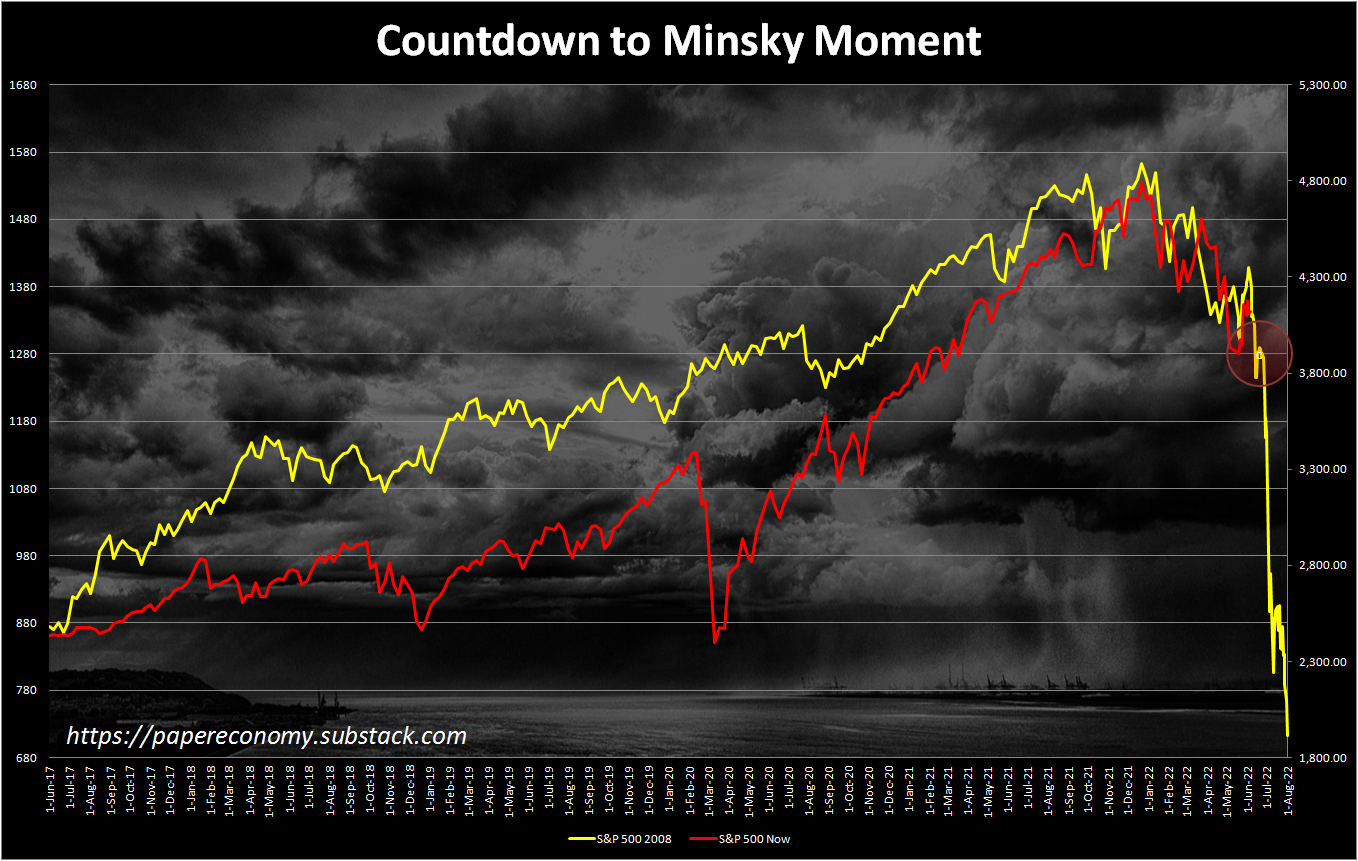
Given all the obvious headwinds, one has to wonder at what point will come the “Minsky Moment”, namely the sudden collapse of asset values as market participants finally reach a collective panic in the face of the mounting evidence that a major downturn is inevitable. 

While there is no way to truly know, let’s see if we can gain any insight in tracking today’s evolution of panic by comparing the current trends in the S&P 500 against the course taken in 2007.

The following data visualization (click for larger view) shows the S&P 500 from the buildup and peak of 2007 bubble overlaid and aligned with the peak of this cycle providing a simple comparison of how a panic can evolve.  Again, history never repeats exactly but this visualization can provide a rough point of comparison and some valuable overall perspective.

Like the above post? Consider subscribing to my Substack for additional insights and content today!

Wednesday, June 01, 2022

Now and Then – A ‘Tightwad’ at the Fed


While the current administration struggles to figure out their position on inflation, forcing Treasury Secretary and former Federal Reserve Chair Janet Yellen into an uncomfortable “mea culpa” and current Fed Char Jerome Powell into a pointless public relations photo op, let’s take a look back at our last major inflationary crisis as a point of comparison with my commentary in bold italics.

In October of 1980, a headline read “’Tightwad’ Volcker puts economy through the wringer” with the author detailing some of the Federal Reserve Chair Paul Volcker personal habits and opining that his handiwork had brought interest rates up to a level not seen since Confederate troops threatened to march on Washington.  Further, it was noted by Business Week that “Shattered confidence in the Carter Administration left the president no choice but to select a man who would be instantly hailed as the savior of the dollar, even though that meant bringing in a Fed chairman far more conservative than Carter would have preferred.”  

By contrast, today, the Biden administration is just beginning to recognize how far they are behind the curve.  When Jimmy Carter nominated Volcker, it was an admission of defeat while today Biden is just beginning to recognize that a fight is on.

In March of 1981, another headline reads “L.A. bank raises prime to 17.5” with the author indicating that various banks were bringing their prime lending rates up by 0.5% as a result of “sharp” increases in the Federal Funds Rate and detailing that “Last week, federal funds were trading as low as 13 percent, but the rate jumped above 15 percent this week.”  Further it was noted by a Security Pacific (the L.A. bank) spokesman that “The federal funds rate has gone up 200 basis points and CD rates about 100 basis points,”

The Federal Funds rate jumping by 200 basis points over the course of a few weeks offers a truly comical contrast to today’s endless worry and handwringing over the Feds prospect of going 25 or 50 bps at the next meeting.  Clearly, we are more attuned to and afraid of the impact that increasing interest rates will have on our asset prices likely as a result of being essentially less resilient and more fearful overall.

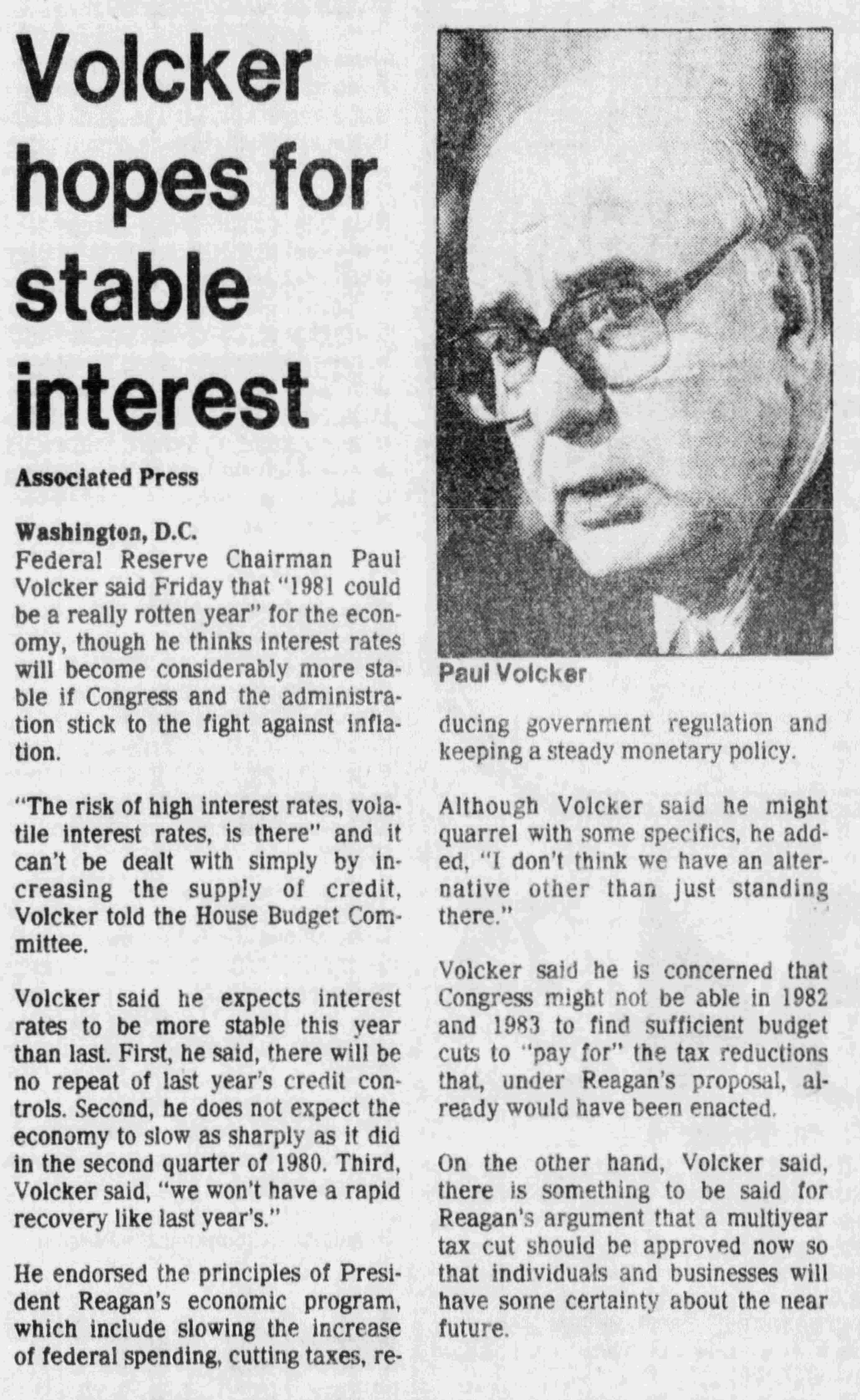
Another March of 1981 headline reads “Volcker Hopes for Stable Interest” within which Fed Chair Paul Volcker is quoted as saying “1981 could be a really rotten year” for the economy indicating further that “The risk of high interest rates, is there” and further still that “we won’t have a rapid recovery like last year’s.”

Clearly, the early 80s were a very different time.  We now find ourselves in an era where a slight wrong choice of words by even just a random member of the FOMC sends world markets reeling. 

Finally, a July of 1981 headline reads “Volcker cools inflation with high rates” within which it is detailed that “The painful readjustments are taking place, as you can hear everywhere from would-be home sellers and buyers in a market almost wiped out by high interest rates, and from small-business people unable to maintain adequate inventories because it costs them 23 percent for money” and concludes “Some of the complaints [about the Feds course of action] will be frivolous.  Some will be self-serving.  And some will come from those who wonder if the chairman knows what he is doing, or whether he is practicing economic bloodletting.”

After two years with a Federal Reserve engaged in a pitched battle with inflation pushing the U.S. into one recession and on the brink of a second (that was to materialize later that year), there was significant uncertainty about the path forward as notable pain was being felt by households and firms. 

Fighting persistent monetary inflation is not just a simple nominal policy course correction; it is a fundamental process of tightening the monetary system by severely contracting the money supply and thoroughly disabusing all market participants of any ideas that the old easy-money regime will ever return.

Like the above post? Consider subscribing to my Substack for additional insights and content today!

Tuesday, May 31, 2022

S&P Core Logic Case-Shiller Home Price Indices – Housing Still Booming


Today’s S&P Core Logic Case-Shiller Home Price Indices Report indicated that nationally, seasonally adjusted home prices increased a notable 2.55% in March rising a whopping 20.55% above the level seen a year earlier.  The 20-city index also increased notably rising 3.07% on the month and 21.17% above the level seen in March 2021 while the 10-city index increased 2.84% and 19.51% respectively. 

It’s important to note that this data lags a bit and that most (if not all) home sales included in today’s data-set likely settled while mortgage interest rates were still in the 3 percent range.
That said, the Case-Shiller home price index is really the “gold standard” in home price data and very accurately reflects the price trends in the tracked markets.  There are other home price indices that also merit attention and I will feature these in due time. 

The methodology behind the Case-Shiller indices was really a significant innovation in that it succeeded in eliminating the distorting effects that are present in the simple median or average home price data published by the National Association of Realtors by utilizing a three month moving average of the price change in numerous sale pairs (i.e. a house that recently transacted with a true “arms-length” sale thereby creating a pair of true market settled prices between the current and last sale) and then value-weighting to adjust for changes in house quality. 

As I understand it, Dr Case and Dr Shiller formulated this approach and implemented the construction of these indices for some time just using research students, a significant achievement given the labor involved in gathering and vetting all the source data.
 

A short digression though… 


 When I was more actively blogging way back in 2008, I was pleasantly surprised by how approachable and accessible Dr Case was.  He was very enthusiastic about interacting through email, over the phone and in person (at presentations) and he even submitted a post for me to exclusively publish on my blog entitled “Why Am I Optimistic” (replete with data, docs and excel files and, funny enough, all attached to a single email entitled “answer to the daggers”) within which he made a very measured and sensible analysis of the housing market and some predictions that, looking back at them now, were pretty darn accurate particularly with respect to the Boston market in which we both lived. 

Further, he was very encouraging of my development of Blytic.com (mothballed at this point... someday I’ll get back to it), an early macro-econ data service very similar to (but pre-dating) the Fed 

Fred system and his feedback was very motivating and made a huge impression on me while I was in the throes of that endeavor. 

When he retired in 2009, I was sad to learn that he had done so because he had unfortunately developed Parkinson’s disease and really saddened to hear of his passing in 2016 at the way too young age of 69. 

Dr Case was a great teacher and even though I never attended a single class of his at Wellesley, my interactions with him over those years leaves me with a sense of being very fortunate to have been one of his many students.  

The following data visualization (click for dynamic view) shows the S&P Core Logic Case Shiller Home Price National Index since late-2006 with the index value (in blue) on the left axis and the year-over-year change (in red) and month-to-month change (in green) on the right axis.

Like the above post? Consider subscribing to my Substack for additional insights and content today!

Monday, May 30, 2022

Great Power, Questionable Responsibility


Financialization, as I have pointed out before, allows for some truly powerful dynamics that would not otherwise be available to market participants but, as the old comic book adage states, “with great power, comes great responsibility” and responsible use of innovations in finance, being subject to the whims and foibles of human nature, has lead to significant economic calamity.

Think of the farmer who has to contend with the ever-changing variables of his trade; weather, pests, labor, material input costs all in advance of the day when his crops or livestock are ready for market and in the hope that the prices they will fetch are favorable by the time he gets them there.

This is clearly a significant challenge and even with decades of direct experience and generations of shared knowledge, success comes with considerable risk and failure comes frequently as the result of circumstances that are beyond his control.

But with the right dose of financial engineering, namely commodity futures contracts and commodity exchange markets, farmers and their counterparts (wholesalers, buyers, etc.) are able to spread risk, allowing participants to enter into “forward” contracts (for delivery of real product) that are themselves “fungible” and able to be continuously traded for better, even more efficient agreements given the ever changing conditions and considerations specific to a given participant.

Commodity futures markets, originally pioneered in the 1700 and 1800s, have been continually modernized to the point where contracts can now be traded digitally through the Chicago Mercantile Exchange (CME) or the New York Mercantile Exchange (NYMEX) by traditional market participants as well as strictly speculative actors who view these contracts as purely financial abstractions traded to gain a desired level of price exposure to a given commodity for their own purposes (e.g. hedge funds and other money manager seeking to perform hedging activity).

Further, in the last two decades, the advent and popularization of the exchange traded fund (ETF) has allowed money managers to utilize digital commodity futures contracts to create highly liquid funds traded as shares on typical stock exchanges with marketable, sometimes even comical ticker symbols (e.g. COW for livestock commodities, CORN for corn, JOE for coffee) thereby allowing retail investors to effortlessly buy and sell these commodities at will through any typical stock trading console and even utilize “put” and “call” options contracts to trade with leverage.

Stop and take a moment to really think about the above detailed scenario; layers of complex financial arrangements standardized and simplified through fungible abstractions that are then pooled and package and digitized, and yet packaged again all working to motivate interests and, more importantly, enabling capital from countless participants to flow freely in vast pools of financial liquidity spreading risk and powering participation on a scale that the original “real” goods market participants could scarcely ever imagine.

But what are the limits of this type of financial engineering?

Commodities, while a great tangible example of successful financial engineering (at least to date that is) are hardly the only asset class in finance involved in packaging, pooling and spreading risk through highly engineered financial innovation.

In 2008, the world was made acutely aware of the potential downsides of financial engineering as the U.S. housing bubble imploded, disclosing the fragility of the highly complex financial arrangements that undergird the U.S. mortgage market.

Who can forget the endless panic and hand wringing that ensued as the various “tranches” of securitized mortgage assets (the famed packaged “mortgage backed securities”) hung in the balance and with each leg down in home prices and up in foreclosures, went bad like so many rotting fruit in baskets of otherwise healthy produce.

Make no mistake, like the commodity example, the whole complex of mortgage financialization was resting on a foundation of real assets, real mortgages tied to actual real estate, that were packaged and re-packaged into financial products that gave the investor class price exposure to the U.S. housing market.

These highly financilized mortgage securities, once viewed as “good-as-gold” nearly riskless investment products found their way into safe income producing funds the world over, and, when the tide turned on housing, sullied whole portfolios, destroying wealth in grand scale and ultimately bringing the global economy to the brink of collapse.

A truer example of shared risk has never existed as foreclosure activity that in past eras would have been born directly by the local banking system within the affected real estate market (or markets… see the Savings and Loan crisis of the late 1980s) instead, decimated the value of assets that were now, through the miracle of financial engineering, spread far and wide.

When the fate of the world economy seemed bleakest, the “Apex-lender of Last Resort”, the Federal Reserve itself, ultimately choose to step in, backstopping and bailing-out failed banks, broker dealers and other financial institutions, absorbing “toxic” assets and thereby assuming the liabilities of a generation of “high finance” who had previously viewed themselves as the “masters of the universe”.

Further, the mortgage market, being seriously impaired (and even non-existent in some lending categories) required the Fed to also step up and start lending through the giant government-sponsored enterprises (GSEs, Fannie Mae, Freddie Mac and Ginnie Mae) in an effort to maintain a degree of market function.

This portion of the Fed’s “quantitative easing” (QE) campaign saw the Fed minting monetary base at breakneck speed, ultimately creating about $2.7 trillion (to date) and deploying that capital by purchasing mortgage-backed securities directly from the GSEs on an on-going basis.

In fact, Bloomberg recently estimated that even today, as much as 30% of the overall U.S. mortgage market is still being financed directly by the Federal Reserve.

So, roughly two thirds of the U.S. mortgage market is organic natural market function while a whopping one third is still, even to this day some thirteen years after the housing debacle, being essentially centrally planned and facilitated by unconventional monetary policy and specifically fueled through direct injection of fiat money creation.

This outcome, unlike the prior commodity example, clearly is not desirable and illustrates the risks involved with financial innovation.

The mortgage market was transformed by financial engineering from a relatively simple and mostly local traditional banking function into a global market of deeply liquid securitized mortgage assets, thereby spreading and even amplifying through leverage, the risk of a single nation’s property market across the entirety of the global financial system.

In the end, the unwinding of this massive financial scheme worked to impair the U.S. economy and degrade the credibility of its central authorities (both fiscal and monetary), thereby undermining the worlds principal monetary regime and leading to our current era of rampant speculation in stocks, housing and other speculative assets and, likely, a new even more difficult economic reckoning as the Fed is now forced to rise to the challenge of somehow drawing down excessive accommodation in the face of the monetary inflation it caused through its own prior policy. 

There is no doubt by now that, through financial engineering, our financial institutions and central authorities are very “powerful” but given all that we have witnessed in the last two decades of economic tumult, one has to wonder if history will ultimately judge us to be truly “responsible”.

Like the above post? Consider subscribing to my Substack for additional insights and content today!

Friday, May 27, 2022

Personal Consumption Expenditures – Gas Prices Drive Inflation

Today’s release of the Personal Income and Outlays Report showed that personal income increased by $89.3 billion in April (rising 0.4% from March) while disposable personal income increased $48.3 billion (rising 0.3%) and personal consumption expenditures increased $152.3 billion (rising 0.9%) over the same period.

Clearly, consumers are increasing spending particularly as the COVID-19 pandemic become more of a distant event and the process of post-pandemic normalization continues but today’s report also indicated that durable goods (appliances, furniture, autos) consumption expenditures increased by 2.4% on the month while nondurable goods (food, fuel , clothing, soap etc.) consumption expenditures actually declined by 0.1% over the same period.

The gasoline and other energy nondurable goods consumption expenditures sub-component increased at a whopping 8.6% on the month while the food nondurable goods consumption expenditures remained largely flat at 0.04%.

So, it appears that consumers are spending significantly more on energy (an obvious fact for anyone filling up at a gas station recently), which is impacting spending on both food and other nondurable goods, a classic stagflationary pricing dynamic.

Historically, increasing energy costs is nearly synonymous with general inflation (a fundamental driver) and very clearly influences the PCE-deflator index (price index baked off of personal consumption expenditures data as opposed to the traditional consumer price index CPI), one of the Feds preferred measures of inflation. 

The following data visualization (click for dynamic version) shows The U.S. Energy Information Administration’s price index for all formulations of gasoline reflecting the weighted average price of gasoline as of this Monday (in blue) on the left axis and the year-over-year percent change (in red) of the Personal Consumption Expenditures deflator index on the right axis.

Notice that the general relationship indicates high correlation between the average price of gasoline and the annual rate of change in the PCE-deflator as well as the fact that (the more timely) gasoline prices appear to be indicating that there is more inflation to come.

Like the above post? Consider subscribing to my Substack for additional insights and content today!

Wednesday, May 25, 2022

Federal Reserve’s FOMC Meeting Minutes - A Transitory, Political Charade

Today’s release of the FOMC meeting minutes shows that the Fed is still way behind the curve as they continue to characterize current inflation as a primarily transitory symptom “… reflecting supply and demand imbalances related to the pandemic, higher energy prices, and broader price pressures” rather than a largely monetary phenomena.

Further, citing the war in Ukraine and the COVID-19 lockdowns in China, the Fed portrays recent world events as “… creating additional upward pressure on inflation”.

This is simply a charade as the Fed adopts a common strategy used in the political arena, attempting to shift the blame of inflation from their own 13-year long escapade of monetary recklessness to a number of recent topical anomalies.

The Fed continues the political spin indicating that they intend to “achieve maximum employment and inflation at the rate of 2 percent over the longer run” and that with the “appropriate firming in the stance of monetary policy, the Committee expects inflation to return to its 2 percent objective and the labor market to remain strong”, a nonsensical goal and conclusion given that the primary purpose of increasing the Federal Funds rate is to create unemployment  (i.e. tighter business conditions leading inevitably to trimming of payrolls).

What we are seeing is a Fed that continues to willingly stay behind the curve likely in a misguided effort to balance political considerations with their actual mandated function.

If the Fed is to really combat monetary inflation (again, caused by their own highly unusual, highly risky policies) they will need to put all political considerations aside and fully embrace their current task of contracting the monetary base and, through that, the economy as a whole.

They will inevitably be causing a “hard landing” resulting in lots of unemployment, a major economic reckoning and much pain for most of the American population but this is the price that needs to be paid in order to ensure fidelity of our economic system.

Like the above post? Consider subscribing to my Substack for additional insights and content today!

Tuesday, May 24, 2022

New Residential Sales and Construction – New Housing Collapse 2.0

Today’s release of the New Home Sales Report shows that housing is now firmly reflecting the negative effects of the quickly darkening economic conditions and sharply rising mortgage rates with sales of new single family homes plunging to a seasonally adjusted annual rate of 591,000, a decline of 16.6% below the prior month’s rate and 26.9% below the rate seen one year ago. 

Further, today the latest release of the New Residential Construction Report showed that, single family permits issued, the most leading of indicators for single family homes, declined 4.6% since the prior month and 3.73% below the level seen one year ago clearly indicating that home builders are pulling back on future supply in the face of the a downdraft in current demand.

The following data visualization (click for dynamic view) shows New Home Sales since 2020 with the index value (in blue) on the left axis and the year-over-year change (in red) and month-to-month change (in green) on the right axis. 

The following data visualization (click for dynamic view) shows New Home Sales since 2005 with the index value (in blue) on the left axis and the year-over-year change (in red) and month-to-month change (in green) on the right axis.

Like the above post? Consider subscribing to my Substack for additional insights and content today!

Monday, May 23, 2022

The Last Kicked Can

Economist Herbert Stein's old adage that “If something cannot go on forever, it will stop", puts our current predicament into perspective perfectly.   

Our economy has been distorted irreparably by negligent monetary and fiscal policy that is reaching an “end-of-life” of sorts, losing effectiveness, revealing consequences and providing yet another painful lesson in the deficiencies of top-down central planning.  

While the mere existence of the Federal Reserve System or any other system of central banks or centralized monetary control for that matter, represents an experiment in financial engineering (… actually there have been a series of failed experiments), our current trial of command-and-control monetary scheming, while long running, has proved to be nothing short of ruinous. 

For the last 50 years, the Federal Government and Federal Reserve, working in tandem, essentially debased our economic system, starting with the final abandonment of the “gold standard” in 1971 (providing the full flexibility of a fake fiat money system) and leading to the present day, after 10 years of post-Great Recession reckless fiscal and monetary policy and 2+years of truly outlandish pandemic-era schemes that saw the Federal Government’s total public debt soar roughly $20 trillion to stand at just over $30 trillion while the Federal Reserve’s total assets (mostly U. S. Treasury securities, about $5.7 trillion, and Federal agency debt and mortgage-backed securities of about $2.7 trillion) bloat by roughly $8 trillion over the same period. 

In the intervening years there were various other lesser "moral hazard" inducing episodes (e.g. Greenspan-era responses to the Crash of 87, LTCM, Dotcom Crash), but what initially set us on our current course of persistent inflation and oncoming economic calamity was the unprecedented and reckless overreaction to the 2007/08 national housing bubble bust which was the moment that fiscal and monetary authorities “crossed the Rubicon” on a one-way escapade that eventually set up the truly distorted and insane response to the COVID-19 pandemic panic. 

In the face of the fear of the consequences of the bursting of the national housing bubble, the Federal Government and Federal Reserve “blinked”, and in a supposed noble attempt to blunt the severity of the oncoming “Great Recession”, “kicked the can down the road” by propping and pumping and bailing using every conceivable means at their disposal and even inventing a number of novel fiscal and monetary schemes as well. 

Never before had the Federal Reserve attempted such a colossal bail out of the entirety of the economic system acting as the apex-lender of last resort, backstopping both troubled financial firms holding illiquid mortgage-backed assets as well as bailing out the Federal Government itself, by stepping up to fill in as an immense direct buyer of government treasury and agency debt securities thereby singlehandedly financing large portions of government policy. 

On the fiscal side of the equation, the Federal Government sought a number of irrational goals; From sanctioning and even assisting failed homeowners in breaking the contractual obligations of their home loans to creating the first never-ending unemployment benefits program, a “clunker” automobile buy-back boondoggle and even bailing out various auto manufactures; from TARP and TANF and HARP to HAMP, the Federal Government left no stone unturned when providing an endless array of unearned “benefits” so long as all efforts appeared to “reinvest” in America and the American Recovery. 

Taken together, these efforts by the Federal Reserve and Federal Government did work to induce confidence in the population, putting a floor under the stock market in March of 2009 (an outcome expressly desired by then Fed Chair Ben Bernanke in 2011) and generally dulling the pain of this epic financial meltdown, but at the cost of the fidelity of our economic system and a future more fundamental reckoning as we are all eventually forced to square off against an inevitable harsh reality. 

Despite much intellectual hand-wringing waving with regard to the Feds post-2008 activities and its effect on the presence or absence of velocity of money; to gain a sense of the scale of their activities, it is important to note that it has been estimated that roughly 30% of the overall U.S. mortgage market is directly financed by the Federal Reserve.  

This means, more specifically, that even to the present day (obviously well beyond the 2007/08 housing collapse), for 30% of all home sale transactions involving a mortgage (i.e. specifically, the transactions involving Fannie Mae, Freddie Mac or Ginnie Mae guaranteed MBS) the mortgage lender is the Federal Reserve itself. 

Where does the Fed get the “money” to provide for all these loans? It just creates it from thin air, a series of bits on their digital balance sheet. 

To put this in perspective, just the roughly $2.7 trillion minted by the Fed expressly for lending through Fannie, Freddie and Ginnie, is equivalent to the total lifetime earnings of over one million U.S. households. 

This level of extensive money creation combined with the “moral hazard” of continuous crisis-politics driven Federal policy has worked to debase our money system as well as our population’s common sense and basic recognition of risk, breeding outsized expectations for the role of government and a lack of respect (domestically at least) for the dollar.  

Taken together, this resulted in a kindling of sorts, laying-in a blanket of potential high energy “money” awaiting a spark to set off a conflagration of pernicious and persistent inflation and ultimately leading to the dreaded wage-price spiral. 

It appears that the COVID-19 panic and the associated period of utter insanity worked to provide that spark, driving authorities to their furthest excursion into fiscal and monetary “la la land” doubling down on all prior malfeasance and radically influencing American’s sense of value leading to epic levels of speculation in stocks, housing and digital tokens and other speculative assets. 

Now, after 13 years of reckless economic mismanagement, we again find ourselves holding the can. 

Our authorities naturally will want nothing more than to stride back and give it another good kick, but this time they won’t because they can’t. 

This approach could not go on forever, so now, finally, it will stop.

Like the above post? Consider subscribing to my Substack for additional insights and content today!

Wednesday, May 18, 2022

Chicago Fed National Financial Conditions Index – Recession Signal


Today’s release of the Chicago Fed National Financial Conditions Index (NFCI) shows pretty clearly that financial conditions are quickly becoming stressed with the index reading 0.012, the first positive value since the panic that ensued in March 2020 due to COVID-19 but, more importantly, the first notable positive reading since the period surrounding the mop-up of the Great Recession. 

The NFCI provides a comprehensive weekly update on U.S. financial conditions in money markets, debt and equity markets and the traditional and “shadow” banking systems.  Positive values indicate financial conditions that are tighter than average, while negative values indicate financial conditions that are looser than average.

A key component of this data-set, the “adjusted” index, isolates a component of financial conditions uncorrelated with economic conditions to provide an update on how financial conditions compare with current economic conditions.

The following data visualization (click for dynamic view) shows the Chicago Fed “Adjusted” National Financial Conditions Index since mid-2007 as well as recession bands denoting the start and end of the “Great Recession” and the “Mini-Recession” that occur following the COVID-19 panic.

Like the above post? Consider subscribing to my Substack for additional insights and content today!

Monday, May 16, 2022

The Fading Trades of the Decade

Oh how the mighty have fallen!  This current stock market rout, which by my reckoning has only just begun, is already taking a serious toll.

The slightest earnings miss or forward guidance disappointment and then… Let the punishment begin!  The Street dumps shares en-masse and issues reset down 10-30%.

In the era of the “Everything Bubble” you should expect no less given this bull-market inflated on trades that were the absolute antithesis of value investing or any other sound long-term, fundamentals-based, investment strategy.  

Short term hyper-enthusiastic blind-speculation is the dominant function of today’s stock-jobber and this type of “investing” (with reckless abandon) is a story as old as “investing” itself and with an inevitable ending that we are well aware of if not yet willing to consciously admit.

But the real bull-run we have today is not in stocks, housing or cryptos but in the ranks of stock-jobbers themselves!   

The Fed’s misguided decade+ long 0%-interest rate policy and associated quantitative easing madness has created the most fundamental and widespread bubble in history… the “Everything Bubble” where white-hot money coupled with a multitude of innovations in financialization and an utter lack of any basic risk-free or nominal-risk real returns has pushed wide swaths of the population, particularly those of retirement age who historically should have no exposure to risky assets, into an excessively speculative posture.

For the young, the downdraft will be similar to the lessons learned by past generations.  They will take their shellacking losing 15-30% on their housing assets or 50-80% on their stock portfolio or 100% on their various crypto holdings or possibly even all three but the primary lesson will be positive, namely that real wealth does not accrue overnight and certainly not as a function of other speculators feverish FOMO.

For the old, the Boomers, on the other hand, we are in uncharted territory!

Far too many Boomers are fully invested and with their average age somewhere in the 60s, this generation is wholly unprepared to either wait-out another major economic collapse or replace the lost wealth through some form of current income.

The most sensible strategy for any Boomer today is to hedge their bets and move away from risk, dispensing with stocks and other highly speculative holdings and preparing for a long, dull and boring period of modest fixed-income particularly as rates reset upwards.  

Boomers may ultimately loose wealth in real-terms with this strategy but even with a 5% annual loss in real purchasing power, they will still have about 60% of their wealth 10 years from now, an obviously better trade than possibly taking a 40%-60% (or more) haircut right now.

But they can’t all de-risk at once!  That’s not really how the game works on Wall Street.

So, what we are seeing today are the makings of an obvious, and probably epic, stock market bust as Boomers race for the exists but, when they fail to all successfully pile out of stocks, what then? 

They will probably ultimately turn to tapping other, more tangible real wealth, such as their housing assets, to fund their ongoing needs.

But in an era of rising interest rates and likely falling home prices (… coming soon), don’t expect them to just take out HELOCs to ATM their current homes.  It will be much more sensible to simply sell their property and set their sights on a new house or condo in a lower cost of living area.

So, you can see where all of this is going… a Fed-fueled highly speculative decades-long frenzy in stocks and other highly risky assets gives way to a transformative macro-economic function as an immense aging generation downshifts to a more sensible, more conservative wealth preservation strategy for the final phase of their lives.

How well we will all manage this complex period of inflation and deflation is hard to predict but, with past periods of economic tumult as a guide, it is safe to say that there will be much friction, many bag-holders, many losers and some winners.

Like the above post? Consider subscribing to my Substack for additional insights and content today!